

Dry eyes: Rune's solution
When Rune was unable to take an important step in the treatment of dry eyes, he had to take the solution into his own hands.
Up to half of all adult Norwegians suffer from dry eyes. Rune was severely afflicted, but found a treatment method that has given him a new quality of life.
Rune Ødegård's (60) eyes were increasingly troubled. Irritation, a sandpaper feeling and dryness were just some of the symptoms. He visited the optician several times and received eye drops, went for treatment with an optometrist, and even went to a public eye specialist - but to no avail.
Over time, he gradually became more sensitive to light and also began to have problems concentrating when using his sharp vision.
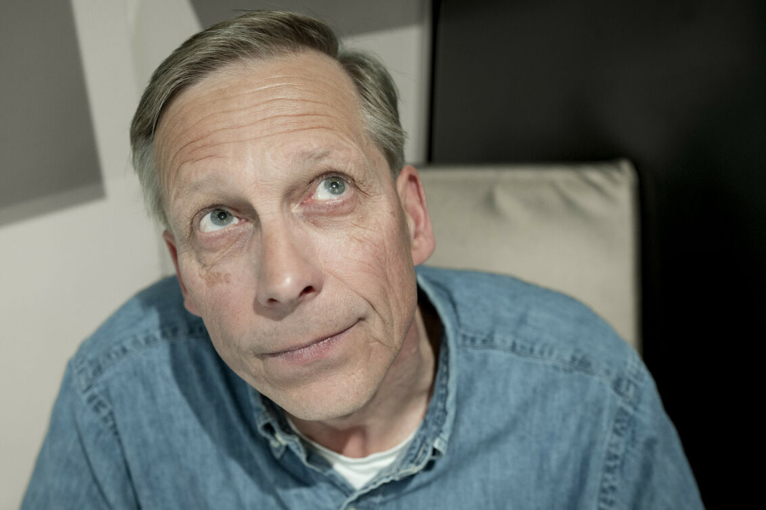
STRONGLY AFFECTED: At one point, Rune was so distressed that he had to drive with one eye closed at a time.
The ailments he had suffered since 2013 ended with a 100 percent sick leave in 2016. He couldn't look at a screen for more than ten minutes at a time without his eyes aching. The correct diagnosis didn't come until the following year: dry eyes.
One eye on the road
"At one point it was so bad that I didn't dare drive anymore. I sat and closed every other eye while I drove," he says.
One December day in 2016, Rune is on his way to the doctor again. He is behind the wheel with one eye closed. On his right side, he has a large field. Suddenly, a hunting dog with an orange coat runs into the road, right in front of the car. Rune brakes abruptly and stops right in front of the dog.
– When I got to the doctor I said: Now you take from me that certificate, says Rune
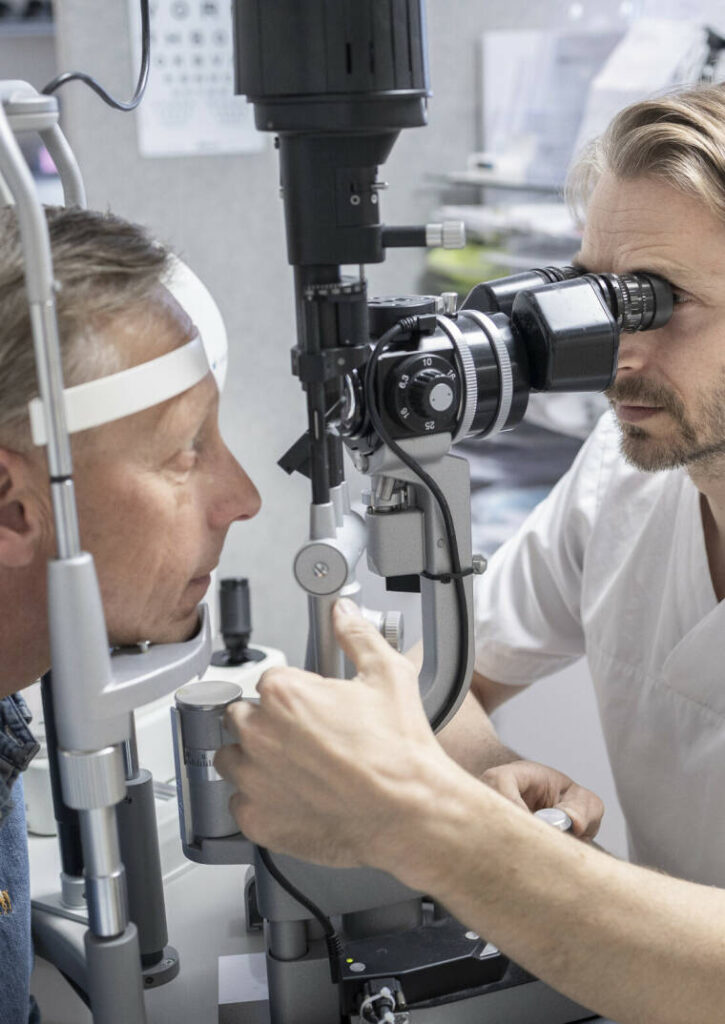
POPULAR DISEASE: According to ophthalmologist Sten Ræder, the most common cause of dry eyes is aging.
What are dry eyes?
Dry eyes are a common eye disease, says ophthalmologist and researcher Sten Ræder. He is the founder and CEO of the Eye Health Clinic and the Dry Eyes Clinic.
Dry eyes are usually treated with artificial tears, eyelid treatment and medication, says the ophthalmologist – but in Rune's case, even more was needed.
Despite the condition being called dry eyes, the most common symptom is watery eyes.
– This paradox comes from the fact that many people have inflamed eyes due to dryness. When the eyes become inflamed, the body tries to correct this – including by producing more tear fluid, which in turn causes watery eyes, explains Ræder.
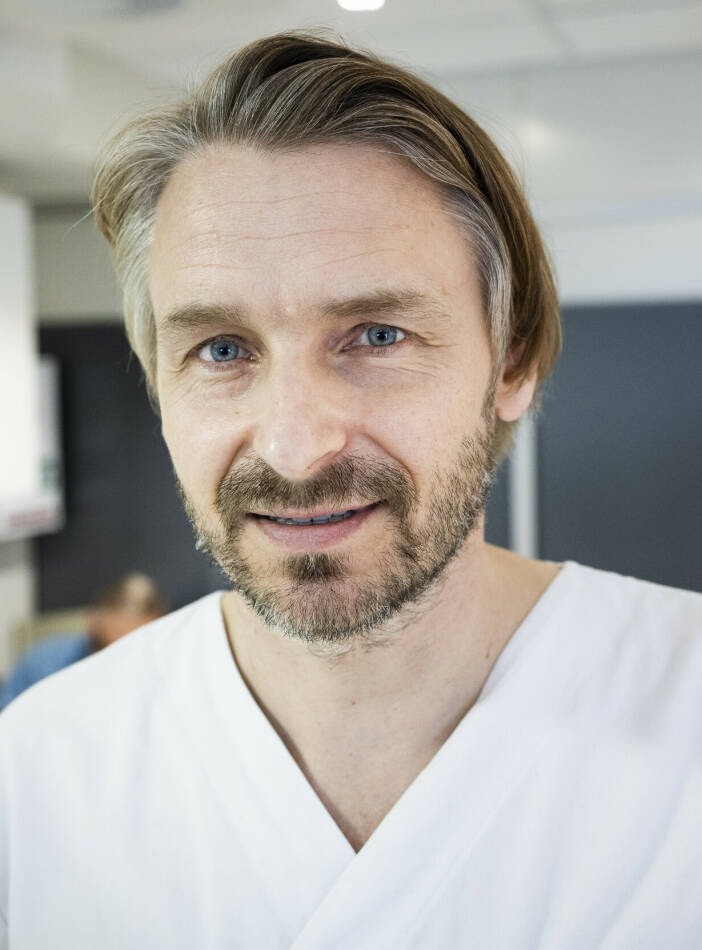
OPHTHALMOLOGISTS: Sten Ræder is an ophthalmologist and general manager at the Dry Eye Clinic and the Eye Health Clinic.
The causes of dry eyes are primarily related to aging. Specifically, the hormonal changes that occur as you get older. The body gradually produces less estrogen and testosterone, which causes the glands that produce water and oils in the eyes to weaken.
– It is specifically the decreased production of lipids that causes dry eyes. The sebaceous glands in the eyelid secrete oil that forms a film over the tear fluid – which means that the tears do not evaporate as quickly. Without the fats, the tear fluid evaporates quickly – so the eyes become dry, according to the ophthalmologist.
Certain medications can also cause dry eyes, such as beta-blockers for high blood pressure, antihistamines for allergies, and isotretinoin for acne, he adds.
When Rune came to Ræder at the Dry Eye Clinic, he learned that he had lost around 75 percent of the sebaceous glands in his eyelids, tear production was very low and he had suffered nerve damage in his cornea.
– If I had come to Sten earlier, it probably wouldn't have been so bad, says Rune.
Scleral lenses
After examination and treatment at Ræder, Rune was referred to Erik Robertstad, general manager at Interoptik Holt in Tønsberg, for the fitting of what are called scleral lenses. Scleral lenses are large lenses that lie like a shield over the surface of the eye.

OPTICIAN: Erik Robertstad
– The lenses come in different sizes – how big you should wear is situational and is an assessment based on each individual case. The lenses are made exactly according to the patient's eye shape, explains Robertstad and continues:
– When you have dry eyes for a long time, nerve damage can occur. The cornea can then become more sensitive – and it takes less time before you are bothered.
Scleral lenses relieve the cornea from dryness, and not least irritation from the friction that occurs when blinking, he adds.
– The lens is fixed in the white of the eye, creating a cavity above the cornea. This cavity is filled with sterile saline so that the cornea has a moist environment, he says.
Candles
Rune got scleral lenses just before Christmas in 2018 – but struggled terribly to get them into his eye.
– Robertstad got me all sorts of tools, but they were so small and fragile. I sat over the mirror with my fingers up to my face – my wife even had to help – but I couldn't do it, he explains.
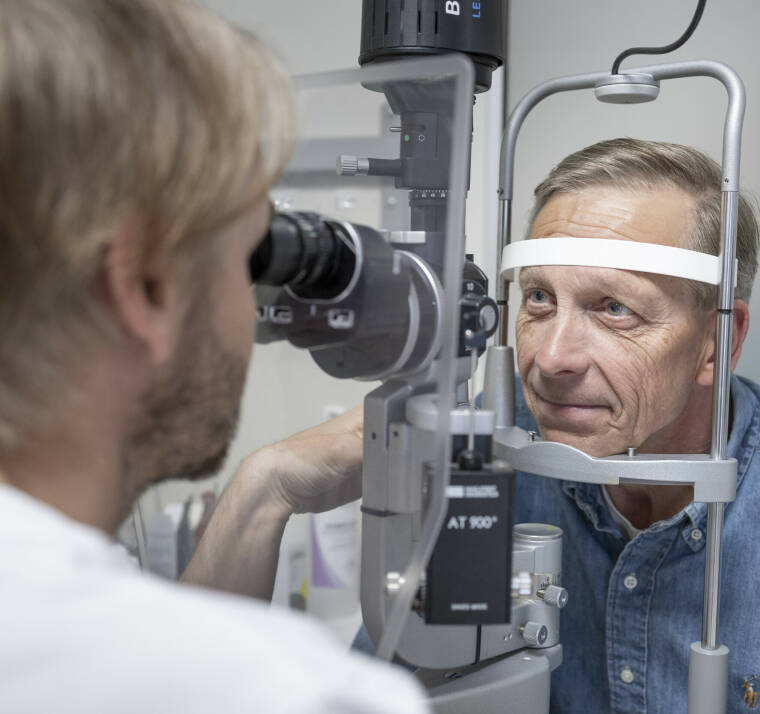
THE DIAGNOSIS: Rune had lost around 75 percent of the sebaceous glands in his eyelids, tear production was very low and he had suffered nerve damage in his cornea.
On Christmas Eve, an angry, frustrated, and red-eyed Rune sat at the living room table, staring at the Christmas tree. His wife began lighting the candles on the tree. An idea suddenly popped into his head.
He took a new Christmas tree candle, burned it down a bit before blowing it out. Then he removed the wick, and washed the tip of the candle. Then he placed the lens in the small bowl that had formed on top of the candle, and filled the lens with saline solution. In this way, he had made himself a small tool that gave him a clear view into his eye, and the lenses went on on the first try.
– It's worth mentioning that I have been declared severely disabled, but it's still bubbling and boiling between my ears, he adds.
Bubbling and boiling eventually became an idea – and with 320,000 kroner in support from Forregion1 Vestfold, the idea became a prototype. The prototype was tested and further developed. After good feedback, Rune made another prototype, this time of a stand, so you can have both hands free to keep your eye open.
– Both the stand and the lens tool work well for both hard and soft lenses. The stand is an extra helping hand for those who need it when applying, says Rune
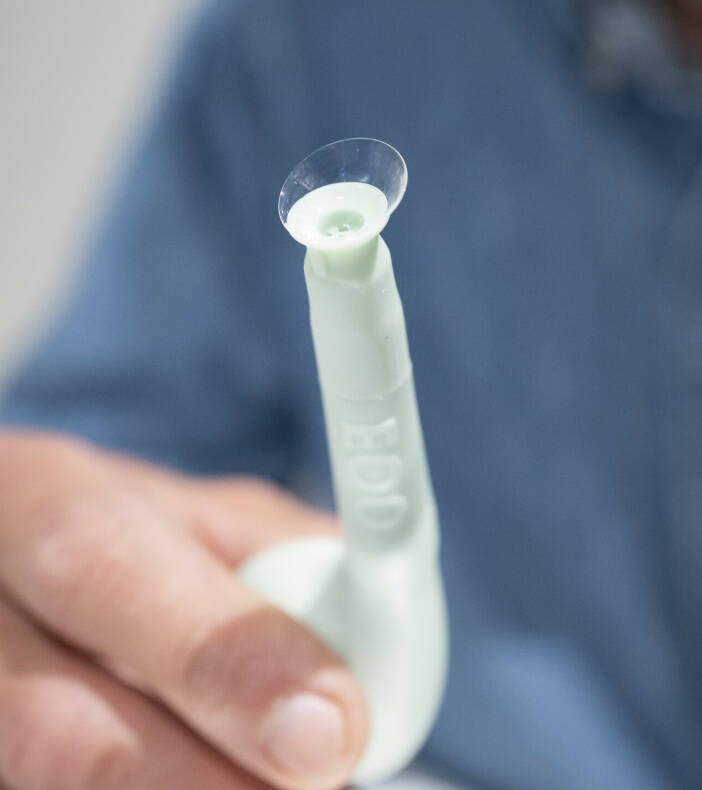
THE PRODUCT: Here Rune shows off the lens tool he has called “Easy On Off”
Today it is still at the prototype stage, but there is hope that it will soon become a finished product ready for sale.
– I have slowly started selling the lens tool, and the machine that will be able to mass-produce the tripod has just been ready, he adds.
Rune emphasizes that he only had the ideas and thoughts surrounding the design of the tool. It is his many good helpers along the way who have done the work that was needed – and should take credit for it being as good as it is, he says.
Well received
The lenses are hard and larger than regular lenses, which makes them a bit more challenging to put on, explains Robertstad. You also have to balance the lens so that you don't lose the saline solution or get any air bubbles.
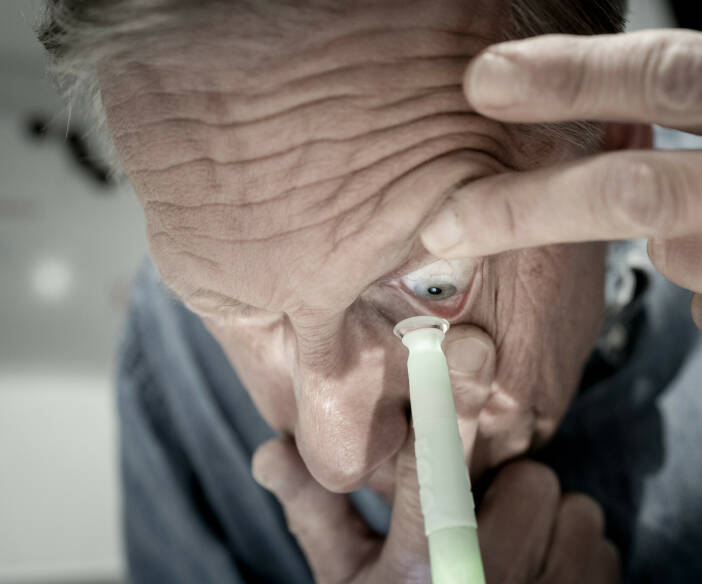
HANDSFREE: Rune demonstrates how the tool frees up both hands.
“You have to keep both your head and the lens horizontal. Then you have to hold your eye open with one hand while you balance and bring the lens up with the other. This is something that many people find frustrating and difficult to do,” he adds.
Robertstad applauds Rune's invention. According to him, for some people this will be a tool that can help them see well, and not least function well in life.
– We already have tools to handle these types of lenses, but he has further developed what already exists and created something that is simply better – and easier to use, he adds.
He himself has contributed professionally – by answering Rune's hundreds of questions – but has no financial ties to the product, only a clinical interest.
– Something worth mentioning is that a colleague and I took Rune's tools down to France – to an optometrist conference. They were very well received there. So now it has been distributed to a selection of professionals around Europe – and the feedback has been very good so far, says Robertstad.
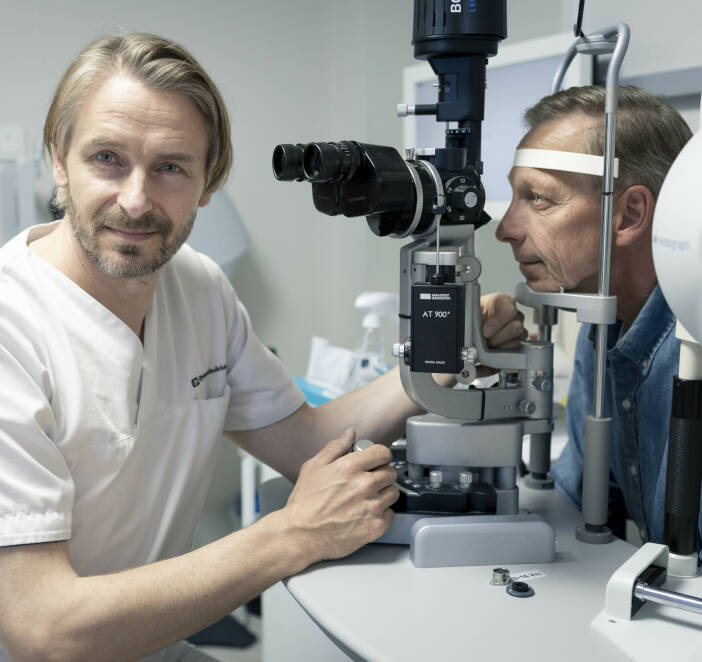
PROFESSIONAL ENVIRONMENT: Sten Ræder says that the professional community has opened its eyes to the tool.
Sten Ræder also praises Rune for the innovation:
– The professional community has opened its eyes to this – and it's really fun that he, as a patient, who himself has the problem, sees a solution that people in the professional community haven't seen.
Restless
Rune had to put his 28-year career as an auditor on the shelf. The illness makes long hours in front of the computer out of the question.
On his own initiative, he started working in the forest. He had no experience or knowledge, but restless as he was, he couldn't just sit at home. A former audit client gave him both a job and training in forestry, for which he is very grateful. This meant that he eventually received training in chainsawing and forest clearing from NAV.
Today he clears forests for Sandefjord Municipality. There he is paid for the area he clears – so he can take as many breaks as he needs, which he is also grateful for:
– All credit to Sandefjord Municipality for taking responsibility and facilitating for me, who is disabled. Still, I have to say that I sometimes miss being an auditor. What I don't miss is a hundred hours of overtime a month – after ten minutes of good focus, my eyes are completely drained, so it's completely out of the question now, says Rune.
First published in Dagbladet: 2023 | By: Sondre Opedal | Photo: Lars Eivind Bones